
15: Legendre Functions#
The Legendre functions \(P_{\lambda}(x)\) and \(Q_{\lambda}(x)\) are the generalization of the Legendre polynomials to non-integer \(\lambda\) and the related Sturm Liouville problem. The Legendre polynomials satisfy (see also 12. Orthogonal Polynomials)
Interval: \(x \in [-1, 1]\).
Weight: \(W(x) = 1\).
Normalization (leading coefficient is \(x^{l}\) with coefficient 1):
\[\begin{gather*} \int_{-1}^{1} P_k(x)P_l(x)\d{x} = \frac{2}{2l+1}\delta_{kl}. \end{gather*}\]Completeness:
\[\begin{gather*} \sum_{l=0}^{\infty} \frac{2l+1}{2}P_{l}(x) P_{l}(y) = \delta(x-y). \end{gather*}\]Generating function:
\[\begin{gather*} \frac{1}{\sqrt{1 - 2xt + t^2}} = \sum_{n=0}^{\infty}P_{l}(x)t^l. \end{gather*}\]
Recurrence Relation:
\[\begin{align*} P_{0}(x) &= 1, \\ P_{1}(x) &= x, \\ (l+1)P_{l+1}(x) &= (2l+1)xP_{l}(x) - lP_{l-1}(x).\tag{15.18} \end{align*}\]Rodrigues’ formula:
\[\begin{gather*} P_{l}(x) = \frac{1}{2^l l!}\diff[l]{}{x}(x^2-1)^l.\tag{15.30} \end{gather*}\]
Schläfli Integral:
\[\begin{gather*} P_{l}(z) = \frac{1}{2^{l}}\oint_C \frac{(w^2 -1)^l}{(w-z)^{l+1}}\frac{\d{w}}{2\pi \I} \end{gather*}\]where the contour is closed, encloses the pole \(w=z\), and avoids any branch cuts (see below).
The Legendre polynomials satisfy the following second-order homogeneous linear differential equation (see also 7. Ordinary Differential Equations (ODEs), 8. Sturm-Liouville Theory):
\[\begin{gather*} (1-x^2)y'' - 2xy' +l(l+1)y = 0, \qquad y(x) = P_{l}(x) \end{gather*}\]
The Legendre functions \(P_{\lambda}(z)\) extend these to non-integer \(l\). This presents the following issues:
The functions are no-longer orthogonal.
The generating function relation should still hold, but now with appropriately defined fractional derivatives. Similarly with Rodrigues’ formula.
The recurrence relations likely hold, but need new based cases for all non-integer streams.
The Schläfli integral is promising, but we must now be careful of the contour since the non-integer power introduced branch cuts.
The differential equation remains valid.
and satisfy
Associated Legendre Functions#
The associated functions \(P^{m}_{l}(x)\) add an extra piece to the differential equation:
They can be found by differentiating:
When \(m\) is even, the set of polynomials \(\bigl\{P^{m}_{l}(x) \quad \mid\quad l\in \{m, m+1, \cdots\}\bigr\}\) forms a completed orthogonal basis. For odd \(m\), we have a similar basis, but the functions are no longer polynomials.
For each value of \(0 \leq m\leq l\), we have a new set of orthogonal polynomials:
Interval: \(x \in [-1, 1]\).
Weight: \(W(x) = 1\).
Orthogonality and Normalization (leading coefficient is \(x^{n}\) with coefficient 1):
\[\begin{gather*} \int_{-1}^{1} P^{m}_{k}(x)P^{m}_{l}(x)\d{x} = \frac{2(l+m)!}{(2l+1)(l-m)!}\delta_{kl}. \end{gather*}\]Note that they also satisfy the following orthogonality for fixed \(l\):
\[\begin{gather*} \int_{-1}^{1} \frac{P^{m}_{l}(x)P^{m}_{l}(x)}{1-x^2}\d{x} = \frac{(l+m)!}{m(l-m)!}\delta_{mn}. \end{gather*}\]Parity:
\[\begin{gather*} P^{m}_{l}(-x) = (-1)^{l-m}P^{m}_{l}(x). \end{gather*}\]Recurrence Relation: (one of many!)
\[\begin{align*} (l-m+1)P^{m}_{l+1}(x) &= (2l+1)xP^{m}_{l}(x) - (l+m)P^{m}_{l-1}(x).\tag{15.88} \end{align*}\]Rodrigues’ formula:
\[\begin{gather*} P^{m}_{l}(x) = \frac{(-1)^{m}}{2^l l!}(1-x^2)^{m/2}\diff[l+m]{}{x}(x^2-1)^l. \end{gather*}\]Schläfli Integral:
\[\begin{gather*} P^{m}_{l}(z) = \frac{(-1)^{m}(l+m)!}{2^{l}l!}(1-z^2)^{m/2} \oint_C \frac{(w^2 - 1)^{l}}{(w-z)^{l+m+1}}\frac{\d{w}}{2\pi \I} \end{gather*}\]where the contour is closed, encloses the pole \(w=z\), and avoids any branch cuts (see below). (MMF: I am not certain yet that the same branch trick works here if \(m\) is not integer since the numerator and denominator have different powers.)
Schläfli Integral Countour#
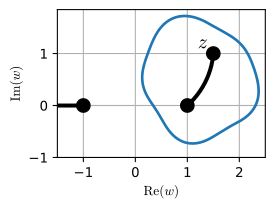
The Legendre function \(P_{l}(z)\) has the following Schläfli contour integral representation:
with the contour shown on the right after choosing the branch cuts as shown.