
Syllabus: Physics 571#
Mathematical Methods for Physics#
Course Information#
Instructor(s): Michael McNeil Forbes
m.forbes+571@wsu.eduCourse Assistants:
Office: Webster 947F
Office Hours: TBD
Course Page: https://schedules.wsu.edu/sectionInfo/&campus=Pullman&prefix=Phys&term=Fall&year=2024&course=571§ion=1
Class Number: 571
Title: Phys 571: Mathematical Methods for Physics
Credits: 3
Recommended Preparation: Linear algebra, differential equations, complex analysis. Methods will be motivated by physical applications, so general exposure to the core concepts of classical mechanics, electromagnetism, quantum mechanics, and statistical mechanics would be helpful, i.e. at the level of our undergraduate Modern Physics 2 course. Basic numerical programming techniques (i.e. Python, NumPy, SciPy, and Matplotlib).
Hypothes.is Group: Click physics-571-fall-2025 to join.
Meeting Time and Location: MWF, 9:00am - 10:00am, Webster 941, Washington State University (WSU), Pullman, WA
Grading: Grade based on assignments and project presentation.
Prerequisites#
Background will be assumed with the foundations of linear algebra, differential equations, and complex analysis. Students interested in the theory track (i.e. those interested in theoretical or mathematical physics) would also benefit significantly from some formal mathematics background – set theory, point-set topology, group theory, analysis, differential geometry etc.
Methods will be motivated by physical applications, so general exposure to the core concepts of classical mechanics, electromagnetism, quantum mechanics, and statistical mechanics would be helpful, i.e. at the level of our undergraduate Modern Physics 2 course.
Students will be expected to check their work numerically, so familiarity with a language like Python and the NumPy and SciPy would be helpful. Instructions on how to use the online CoCalc computational platform will be provided, so students need to provide their own software, compilers, etc.
Textbooks and Resources#
 |
 |
 |
Required#
- Arfken et al., 2013: “Mathematical Methods for Physicists: A Comprehensive Guide”
This is the primary textbook for the course. It has good coverage and will be a good reference for future work, but lacks mathematical sophistication (i.e. few proofs or discussion of formal structures).
Additional Resources#
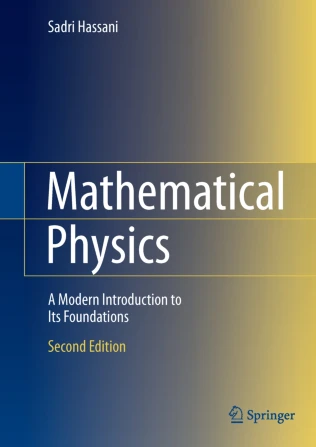
- Hassani, 2013: “Mathematical Physics: A Modern Introduction to Its Foundations”
This is a supplemental resource for those students interested in pursuing theoretical or mathematical physics. It provides a much more rigorous background into the mathematical methods discussed in [Arfken et al., 2013], but might be hard to digest for students without sufficient mathematical preparation (formal proofs etc.) All students are highly encouraged to try to assimilate as much as possible from this resource, but this is not a requirement for success in the course.
- Mathews and Walker 1970: “Mathematical Methods of Physics”
This is an older book, but some topics are presented very well and use it extensively to prepare my notes. It is quite terse, and therefore short. This is maybe not so great for learning the first time, but very good for quickly reviewing the important points.
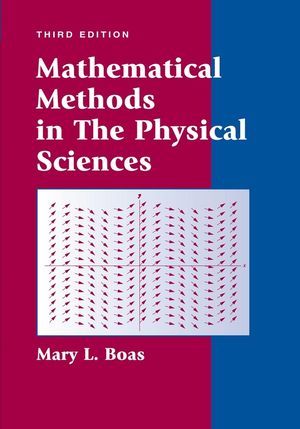
- Boas 2016: “Mathematical Methods in the Physical Sciences”
Another standard textbook for this topic that is somewhat easier to read, but not quite as comprehensive. Students who have difficulty reading [Arfken et al., 2013] might find this easier.
- Graham 1994: “Concrete Mathematics”
This book [Graham et al., 1994] is deep and the place to go if you need exact results about sequences. It develops a full analog to calculus but for finite difference operators, allowing one to “differentiate” and “integrate” series exactly. I highly recommend reading at least the first chapter for insights into how one might approach problems of this type with a combination of guess and check, exploration, and finally formal proof.
- Bornemann 2004: “The SIAM 100-digit challenge: a study in high-accuracy numerical computing”
This is an excellent and fun book describing methods for solving problems posed in Nick Trefethen’s 100-digit Challenge. It is where I learned about sequence acceleration techniques like Levin’s \(u\)-transformation, which I often use when quickly trying to solve a very hard sequence.
Student Learning Outcomes#
By the end of this course, students will:
Be aware of the standard techniques of mathematical physics.
Be able to quickly apply these techniques to well-posed problems.
Be able to formulate such well-posed problems to solve general physics problems.
-
(Theory Track): Understand the mathematical formulation of the techniques and how to prove key results.
Expectations for Student Effort#
For each hour of lecture equivalent, all students should expect to have a minimum of two hours of work outside class. All students are expected to keep up with the readings assigned in class, ask questions in class and through the Perusall/Hypothes.is forums, and complete homework on time.
Assessment and Grading Policy#
Students will be assessed with weekly assignments to ensure that the content-based learning outcomes 1 and 2 are realized. To ensure students have enough practice, problems will be designed so that students can self-assess using numerical techniques to check their work. Students will be expected to self-assess before handing in the assignments – those who cannot reconcile the numerical checks with their analytic work are expected to seek help from the instructor prior to submitting their assignment.
Included in several of these weekly assignments will be larger more abstract physics problems that required the use of a combination of previous techniques to assess learning outcome 3.
Students are expected to keep up with the assigned readings. To encourage students to do this, at the start of every class, one or more students will be selected at random to present the solution to one of the Examples or Exercises in the reading. The participation portion of the grade will be assigned based on these presentations with full points awarded if the students demonstrate that they have engaged with the required reading. This participation grade does not depend a successful answering of the question (see below).
Rational
There is a lot of material to be covered – far too much to be thoroughly presented in the available class time. Furthermore, students are arriving with very different backgrounds. To ensure mastery, students must engage with the material by reading the textbook, and by working through problems.
Typically in my courses, I try to structure the exams to mirror the qualifying exams – a written portion followed by an oral exam. This works well for more complex problems in courses like Classical Mechanics, but is not well suited to a course like this where there are many small techniques to learn, so traditional in-class exams will be used instead.
That being the case, I still want to ensure you have experience answering questions orally as will be required in the qualifying examinations. Remember – you are not being graded on your solution, only that you have engaged with the material and are ready to learn in class. If you have questions about the material, you are encouraged to ask them during your presentation.
Why not just use the assignments? Unfortunately, students seem to have the misconception that finding solutions online and reading these is sufficient preparation. Generating truly unique problems that are not too burdensome is extremely challenging, thus, using online resources is often a good way to get a good assignment grade without learning the material well. (This is cheating, but it is virtually impossible to prevent/detect.) In my experience, the best way to check if students have sufficiently understood the material is to interact with them asking questions, and given the time limitations of the course, this is the best approach I have found.
Students in the theory track will be presented with several alternative problems that emphasize more mathematical approaches, including proofs of key results, assessing learning outcome 4.
10% Participation
20% Assignments (Never accepted late)
20% First Midterm
20% Second Midterm
30% Final Exam (Wed 11 December 2024: 8am-10am)
The final grade will be converted to a letter grade using the following scale:
Percentage P |
Grade |
|---|---|
90.0% ≤ P |
A |
85.0% ≤ P < 90.0% |
A- |
80.0% ≤ P < 85.0% |
B+ |
75.0% ≤ P < 80.0% |
B |
70.0% ≤ P < 75.0% |
B- |
65.0% ≤ P < 70.0% |
C+ |
60.0% ≤ P < 65.0% |
C |
55.0% ≤ P < 60.0% |
C- |
50.0% ≤ P < 55.0% |
D+ |
40.0% ≤ P < 50.0% |
D |
P < 40.0% |
F |
Attendance and Make-up Policy#
While there is no strict attendance policy, students are expected attend an participate in classroom activities and discussion. Students who miss class are expected to cover the missed material on their own, e.g. by borrowing their classmates notes, reviewing recorded lectures (if available), etc.
Course Timeline#
Here is a plausible approach to completely reviewing Arfkin in the ~38 lectures we have. This schedule will be rearranged as needed to match the ability of the students.
Date |
Arfken |
Hassani |
Comments |
|---|---|---|---|
|
(Qualifying Exams - No class) |
||
20 Aug |
|||
22 Aug |
1.1-1.2 |
Series |
|
25 Aug |
1.3-1.9 |
Binomial theorem, Vectors, Derivatives |
|
27 Aug |
1.10-2.1 |
Complex, Integrals, Delta functions |
|
29 Aug |
2.2-3.1 |
Matrices, Vector spaces |
|
|
(Labour Day - No class) |
||
3 Sep |
3.2-3.6 |
3D Vectors |
|
5 Sep |
3.7-3-10 |
Vector Calculus |
|
8 Sep |
5.1-5.7 |
Vector spaces. |
|
10 Sep |
6.1-6.5 |
Eigenvalues |
|
12 Sep |
3.7-3-10 |
Vector Calculus |
|
15 Sep |
4.1-4.4 |
26, 28 |
Tensors |
17 Sep |
36, 37 |
Tensors Cont. |
|
19 Sep |
Tensors Cont. |
||
22 Sep |
7.1-7.5 |
14 |
ODEs |
24 Sep |
7.6-7.8 |
14.5 |
Inhomogeneous ODEs |
26 Sep |
8.1-8.5, 12.1 |
19, 7.2.1 |
Sturm-Liouville Theory, Orthogonal Polynomials |
29 Sep |
9.1-9.3 |
PDEs |
|
1 Oct |
PDEs continued |
||
3 Oct |
9.5-9.8, 10.1-10.2 |
Bases and Green’s Functions |
|
6 Oct |
Midterm I |
||
8 Oct |
PDE/Green’s Function Review |
||
10 Oct |
11.1-11.6 |
Complex analysis |
|
13 Oct |
11.1-11.6 |
Double Class: Complex analysis continued. |
|
15 Oct |
11.7-11.10 |
Residues |
|
17 Oct |
17 |
Group Theory (skim and ask questions) |
|
20 Oct |
12.1-12.5 |
Ortho. Polynomials/\(B_n\)/Zeta/Asymptotic Series |
|
22 Oct |
12.6-12.8 |
Steepest descent. Dispersion. |
|
24 Oct |
13.1-13.6 |
\(\Gamma\) etc. More Functions (\(\zeta\)) |
|
27 Oct |
19 |
Fourier Series |
|
29 Oct |
20.1-20.5 |
Integral Transforms |
|
31 Oct |
20.6-20.10 |
Laplace transform. Bit long. |
|
3 Nov |
21 |
Integral equations. |
|
5 Nov |
23.1-23.4 |
Probability and Statistics |
|
7 Nov |
Monte Carlo/Sampling |
||
10 Nov |
Laplace transform. Bit long. |
||
12 Nov |
20.6-20.10 |
Laplace transform. Bit long. |
|
14 Nov |
21 |
Integral equations. |
|
17 Nov |
Midterm II |
||
19 Nov |
22.1-22.3 |
Calculus of Variations |
|
21 Nov |
22.4 |
Constraints (short) |
|
24 Oct |
16.1-16.4 |
Angular Momentum (Too long?) |
|
|
(Thanksgiving - No class) |
||
|
(Thanksgiving - No class) |
||
|
(Thanksgiving - No class) |
||
28 Oct |
15.5-15.6 |
Spherical harmonics (short). |
|
30 Oct |
17.1-17.6 |
Finite groups. |
|
1 Nov |
17.7-17.10 |
Continuous groups. |
|
1 Dec |
23.1-23.4 |
Probability and Statistics (Dead week) |
|
3 Dec |
23.5-23.7 |
(Dead week) |
|
5 Dec |
(Dead week) |
||
8 Dec |
Final Exam 8-10am |
||
4.5-4.7 |
Differential forms - defer? |
||
15.1-15.4 |
Legendre functions. Likely left as reference |
||
18.1-18.4 |
More Special Functions. |
||
18.5-18.8 |
|||
14.1-14.3 |
Bessel functions. Likely used as reference. |
||
14.4-14.7 |
|||
16.1-16.4 |
Angular Momentum (Too long?) |
||
15.5-15.6 |
Spherical harmonics (short). |
||
17.1-17.6 |
Finite groups. |
||
17.7-17.10 |
Continuous groups. |
Other Information#
Policy for the Use of Large Language Models (LLMs) or Generative AI in Physics Courses#
The use of LLMs or Generative AI such as Chat-GPT is becoming prevalent, both in education and in industry. As such, we believe that it is important for students to recognize the capabilities and inherent limitations of these tools, and use them appropriately.
To this end, please submit 4 examples of your own devising:
Two of which demonstrate the phenomena of “hallucination” – Attempt to use the tool to learn something you know to be true, and catch it making plausible sounding falsehoods.
Two of which demonstrate something useful (often the end of a process of debugging and correcting the AI).
Note: one can find plenty of examples online of both cases. Use these to better understand the capabilities and limitations of the AIs, but for your submission, please find your own example using things you know to be true. If you are in multiple courses, you may submit the same four examples for each class, but are encouraged to tailor your examples to the course.
Being able to independently establish the veracity of information returned by a search, an AI, or indeed any publication, is a critical skill for a scientist. If you are the type of employee who can use tools like ChatGPT to write prose, code etc., but not accurately validate the results, then you are exactly the type of employee that AI will be able to replace.
Any use of Generative AI or similar tools for submitted work must include:
A complete description of the tool. (E.g. “ChatGPT Version 3.5 via CoCalc’s interface” or Chat-GPT 4 through Bing AI using the Edge browser”, etc.)
A complete record of the queries issued and response provided. (This should be provided as an attachment, appendices, or supplement.)
An attribution statement consistent with the following: “The author generated this <text/code/etc.> in part with <GPT-3, OpenAI’s large-scale language-generation model/etc.> as documented in appendix <1>. Upon generating the draft response, the author reviewed, edited, and revised the response to their own liking and takes ultimate responsibility for the content.”
Violation of this policy may result in failure of the assignment or course.
Academic Integrity#
You are responsible for reading WSU’s Academic Integrity Policy, which is based on Washington State law. If you cheat in your work in this class you will:
Fail the course.
Be reported to the Center for Community Standards.
Have the right to appeal the instructor’s decision.
Not be able to drop the course or withdraw from the course until the appeals process is finished.
If you have any questions about what you can and cannot do in this course, ask your instructor.
If you want to ask for a change in the instructor’s decision about academic integrity, use the form at the Center for Community Standards website. You must submit this request within 21 calendar days of the decision.
University Syllabus#
Students are responsible for reading and understanding all university-wide policies and resources pertaining to all courses (for instance: accommodations, care resources, policies on discrimination or harassment), which can be found in the university syllabus.
Students with Disabilities#
Reasonable accommodations are available for students with a documented disability. If you have a disability and need accommodations to fully participate in this class, please either visit or call the Access Center at (Washington Building 217, Phone: 509-335-3417, E-mail: mailto:Access.Center@wsu.edu, URL: https://accesscenter.wsu.edu) to schedule an appointment with an Access Advisor. All accommodations MUST be approved through the Access Center. For more information contact a Disability Specialist on your home campus.
Campus Safety#
Classroom and campus safety are of paramount importance at Washington State University, and are the shared responsibility of the entire campus population. WSU urges students to follow the “Alert, Assess, Act,” protocol for all types of emergencies and the “Run, Hide, Fight” response for an active shooter incident. Remain ALERT (through direct observation or emergency notification), ASSESS your specific situation, and ACT in the most appropriate way to assure your own safety (and the safety of others if you are able).
Please sign up for emergency alerts on your account at MyWSU. For more information on this subject, campus safety, and related topics, please view the FBI’s Run, Hide, Fight video and visit the WSU safety portal.
Students in Crisis - Pullman Resources#
If you or someone you know is in immediate danger, DIAL 911 FIRST!
Student Care Network: https://studentcare.wsu.edu/
Cougar Transit: 978 267-7233
WSU Counseling and Psychological Services (CAPS): 509 335-2159
Suicide Prevention Hotline: 800 273-8255
Crisis Text Line: Text HOME to 741741
WSU Police: 509 335-8548
Pullman Police (Non-Emergency): 509 332-2521
WSU Office of Civil Rights Compliance & Investigation: 509 335-8288
Alternatives to Violence on the Palouse: 877 334-2887
Pullman 24-Hour Crisis Line: 509 334-1133