Assignment 4: Tensors#
Due Mon 22 Sep 2025 at the start of class
1. Antisymmetric Tensors#
Consider a real antisymmetric tensor \(B^{ij} = -B^{ji}\) in 3D. Count the degrees of freedom, and show that any such tensor can be written
Write out \(B^{mn}\) explicitly as a matrix showing where the three components \(A_{1}\), \(A_{2}\), and \(A_{3}\) go, then use the properties of the Levi-Civita symbol to show that
This is important for embedding the electromagnetic field \(\vect{B}\) into the electromagnetic field tensor \(F^{\mu\nu}\).
2. Diagonal Metric#
If the covariant basis vectors \(\boldsymbol{\varepsilon_{i}}\) are orthogonal, show that:
\(g_{ij}\) is diagonal.
\(g^{ii} = 1/g_{ii}\) (no summation).
\(\norm{\boldsymbol{\varepsilon^{i}}} = 1/\norm{\boldsymbol{\varepsilon_{i}}}\).
Note
The notation here is from Arfken, but differs slightly from what I have been using in class and in these notes in 4. Tensors and Manifolds. In these notes, I have used the notation \(\ket{X_{\alpha}} \equiv \boldsymbol{\varepsilon_{i}}\) for the basis vectors and \(\ket{X^{\alpha}}\equiv \boldsymbol{\varepsilon^{i}}\) for the contravariant basis vectors, though, as I argue there, the latter are quite unnatural and should only be used when absolutely needed.
3. Covariant Derivative#
Verify that \(V_{i;j} = g_{ik}V^{k}_{;j}\) by showing that
I.e., show that the correction piece in the covariant derivative changes sign when differentiating vectors (positive sign) vs covectors (negative sign).
4. Christoffel Symbols#
Consider a two-dimensional space defined by the surface of a sphere of radius \(r\). The square of the line element is given by
Determine the coefficients of the metric tensor in both covariant form, \(g_{ij}\) and contravariant form \(g^{ij}\).
Evaluate all nonzero Christoffel symbols of the first and second kind.
Use these to show that
\[\begin{gather*} L^2 = \vect{L}\cdot\vect{L} = -\frac{1}{\sin\theta}\pdiff{}{\theta}\left(\sin\theta \pdiff{}{\theta}\right) - \frac{1}{\sin^2\theta}\pdiff[2]{}{\phi} \end{gather*}\]from last week by directly acting \(\vect{L}\) on a test function twice:
\[\begin{gather*} \vect{L} = \I\left( \ket{\hat{e}_{\theta}}\frac{1}{\sin\theta}\pdiff{}{\phi} - \ket{\hat{e}_{\phi}}\pdiff{}{\theta} \right). \end{gather*}\]
5. Jacobians#
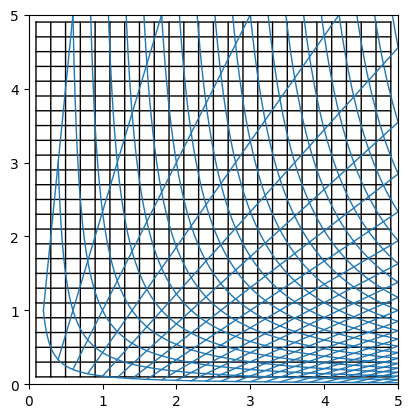
For the transformation (with \(x\geq 0\) and \(y \geq 0\))
compute the following Jacobian in two ways:
By direct computation.
By first computing \(\mat{J}^{-1}\).
Compute the induced metric \(g_{ij}\) in the coordinates \((u, v)\).