Deuteron#
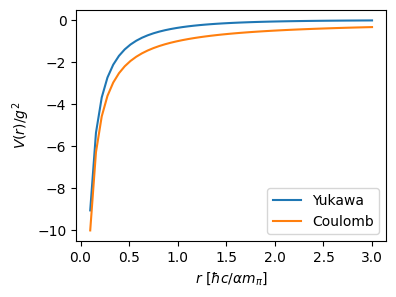
Here we say a little more about Example 8.3.3 in [Arfken et al., 2013]. The key physical idea is that the nuclear potential is short-ranged. Technically this means that it falls off faster than the Coulomb potential \(V \sim 1/r\), but
Specifically, we show that in the short-range limit, the potential has a peculiar structure. The naïve choice of \(V_0\delta^3(\vect{r})\) is too singular, but we need a combination of two parameters to get the correct short range boundary condition.
Example: Top-Hat Potential#
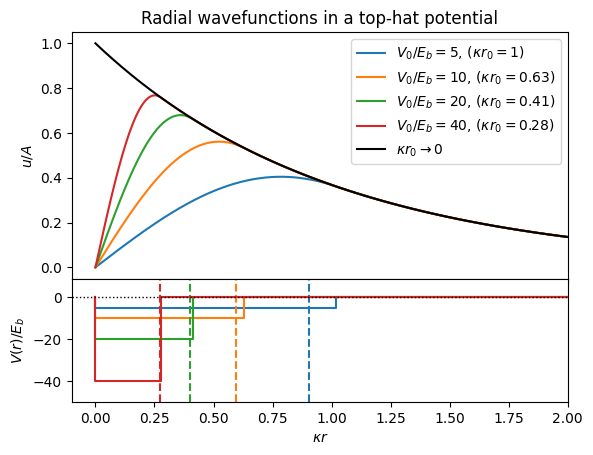
To see this, consider an explicit realization of a top-hap potential \(V(r) = -V_0\Theta(r_0-r)\) with depth \(-V_0\) and range \(r_0\). The bound-states \(E = -E_b\) of the radial wavefunction have the following solutions
Combining these, we have the transcendental equation.
Taking \(V_0 \rightarrow \infty\), we can expand this to obtain the limiting behaviour in the short-range limit for fixed binding energy \(E_b\):
Details
Let \(x = E_b/V_0 \rightarrow 0\).
We can then use the series reversion formula to compute
Then we have
Note: There is something wrong here with the higher order terms. Leading order works out.
Note that this is a very peculiar limiting behaviour. The leading order behaviour has constant \(V_0 \propto 1/r_0^2\) which is independent of the binding energy \(E_b = \hbar^2\kappa^2/2m\). This is a two-dimensional delta-function: more singular than a single delta-function, but not as singular as the 3D delta-function discussed in [Lepage, 1997]. Thus, in order to specify the universal low-energy behaviour of short-range potentials, one needs a special type of pseudo-potential that can be constructed using selectors [Tan, 2005].
We can understand the effect here in two steps:
The second order term has constant \(V_0 r_0\): this is a delta-function in 1D, and can give the kink in the wavefunction that develops as we take \(r_0 \rightarrow 0\). However, representing the potential for \(u(r)\) as \(c\delta(r)\) by itself should have no effect since the radial wavefunction \(u(0) = 0\) vanishes.
Thus, we need something even stronger to “kick” \(u(0)\) to a finite value before the delta-function above can be used to specify the magnitude of the kink, and therefore fix the energy. This is the leading order piece with \(V_0 r_0^2\) that is independent of \(\kappa\) and \(E_b\).
This is why Tan needs a combination of two selectors [Tan, 2005].